7 Powerful Ways to Understand free coin crypto Safely in 2026 😎
Disclaimer: This article is for educational purposes only. It is not financial advice. Cryptocurrency can be risky, volatile, and unsafe if you do not research carefully.
What Is Free Coin Crypto? 😎
free coin crypto is a phrase many beginners use when searching for ways to receive cryptocurrency without buying it directly. In simple words, it usually means crypto coins or tokens that are offered through a promotion, reward program, airdrop, learning campaign, giveaway, or community event.
Sounds exciting, right? Well, yes—but there is a catch. Not every “free crypto” offer is real. Some are honest marketing campaigns from new blockchain projects. Others are scams designed to steal wallet access, personal details, or money.
Cryptocurrency is digital money or a digital asset that runs on blockchain technology. Unlike regular money, crypto is not always controlled by one bank or government. Because it is digital and global, it can move fast. That speed can be useful, but it also creates risks for new users.
Free crypto rewards often appear in the form of tokens. A token may represent access to a project, voting power in a community, game rewards, or a digital asset that can be traded. However, some tokens may have little or no value. Others may become valuable only if the project grows.
The main idea is simple: projects sometimes give away tokens to attract attention. It is similar to a company giving free samples at a store. The goal is to let people try the product, join the community, and talk about it online.
How Free Crypto Coins Usually Work 📧
Free crypto coins are usually distributed through a few common methods. Understanding these methods helps you avoid confusion and stay safer.
*Airdrops
An airdrop is when a crypto project sends tokens to users, often as a reward for early support. Sometimes users must complete simple tasks, such as joining a newsletter, following a project update, or holding a related token.
Real airdrops should never ask for your private key or seed phrase. If a website asks for those, it is a major danger sign.
*Learn-to-Earn Rewards
Some platforms reward users for learning about crypto. You may watch a short lesson, answer a quiz, and receive a small crypto reward. This can be one of the safer ways to learn, especially when the platform is well-known and trusted.
*Referral Bonuses
Some crypto apps reward users for inviting friends. However, this can become risky if the platform is unknown or makes big promises. A good referral program should be clear, legal, and honest.
*Testnet Rewards
Blockchain projects may ask users to test a new network before launch. In some cases, testers later receive tokens. But rewards are never guaranteed, so users should not treat testnets like a sure way to earn money.
Why Projects Give Away Free Crypto 🎯
Crypto projects give away tokens for several reasons. First, they want visibility. The crypto world is crowded, and airdrops can help a new project get noticed quickly.
Second, projects want users. A blockchain network is more useful when many people test it, trade on it, or build on it. Free tokens may encourage early users to try the platform.
Third, projects want community growth. In crypto, communities matter a lot. People join chats, read updates, vote on changes, and promote projects. A token giveaway can help build that community.
Fourth, some projects use free tokens to reward loyalty. Early users who tested a product, joined events, or helped report bugs may receive rewards later.
Still, users should stay realistic. A free token is not always valuable. It may not be listed on major exchanges. It may drop in price. It may also fail if the project does not grow.
Benefits of Free Crypto Rewards ✅
Free crypto rewards can be useful when handled carefully. For beginners, they provide a low-cost way to learn how wallets, transactions, and blockchain apps work.
One benefit is education. Instead of risking your own money, you may learn with small rewards. This can help you understand basic crypto terms like wallet address, gas fee, token, blockchain, and transaction
hash.Another benefit is early access. Some airdrops introduce users to new tools before they become popular. This may include decentralized apps, games, NFT platforms, or blockchain networks.
Free rewards can also encourage people to read project documents. This builds better research habits. In crypto, research is not optional—it is essential.
| Benefit | Why It Matters |
|---|---|
| Low-cost learning | Beginners can explore crypto without buying large amounts. |
| Community access | Users can join project groups and learn from updates. |
| Early discovery | Some users find new projects before they become widely known. |
| Skill building | Users learn wallet safety, transactions, and research habits. |
Risks You Must Know First ⚠️
The biggest risk with free crypto is scams. Scammers know that the word “free” attracts attention. They may create fake websites, fake social media pages, fake wallet pop-ups, or fake support accounts.
According to the U.S. Federal Trade Commission, crypto scams often involve false promises, pressure, impersonation, or requests for payment. The SEC has also warned that fraudsters use crypto popularity to lure people into scams.
Another risk is wallet draining. This happens when a user connects a wallet to a malicious site and approves a harmful transaction. The user may think they are claiming a reward, but they are actually giving permission for assets to be moved.
There is also privacy risk. Some fake giveaways ask for your email, phone number, ID, or social accounts. This data can be misused later.
Finally, there is market risk. Even real free tokens may lose value. Crypto prices can rise and fall quickly. A token that looks exciting today may be worth very little tomorrow.
How to Spot Fake Free Crypto Offers 🚩
Fake crypto offers often share the same warning signs. Watch for these red flags before clicking, connecting, or claiming anything.
- -They ask for your seed phrase: Never share it. Ever.
- -They promise guaranteed profit: No crypto reward is guaranteed to make money.
- -They pressure you to act fast: Scammers love countdown timers.
- -They use fake celebrity posts: Public figures are often impersonated.
- -They ask you to send crypto first: A real free reward should not require payment.
- -The website URL looks strange: Misspelled domains are common scam tools.
- -The team is hidden: Lack of transparency is a major concern.
A helpful rule is this: if it sounds too good to be true, pause and research.
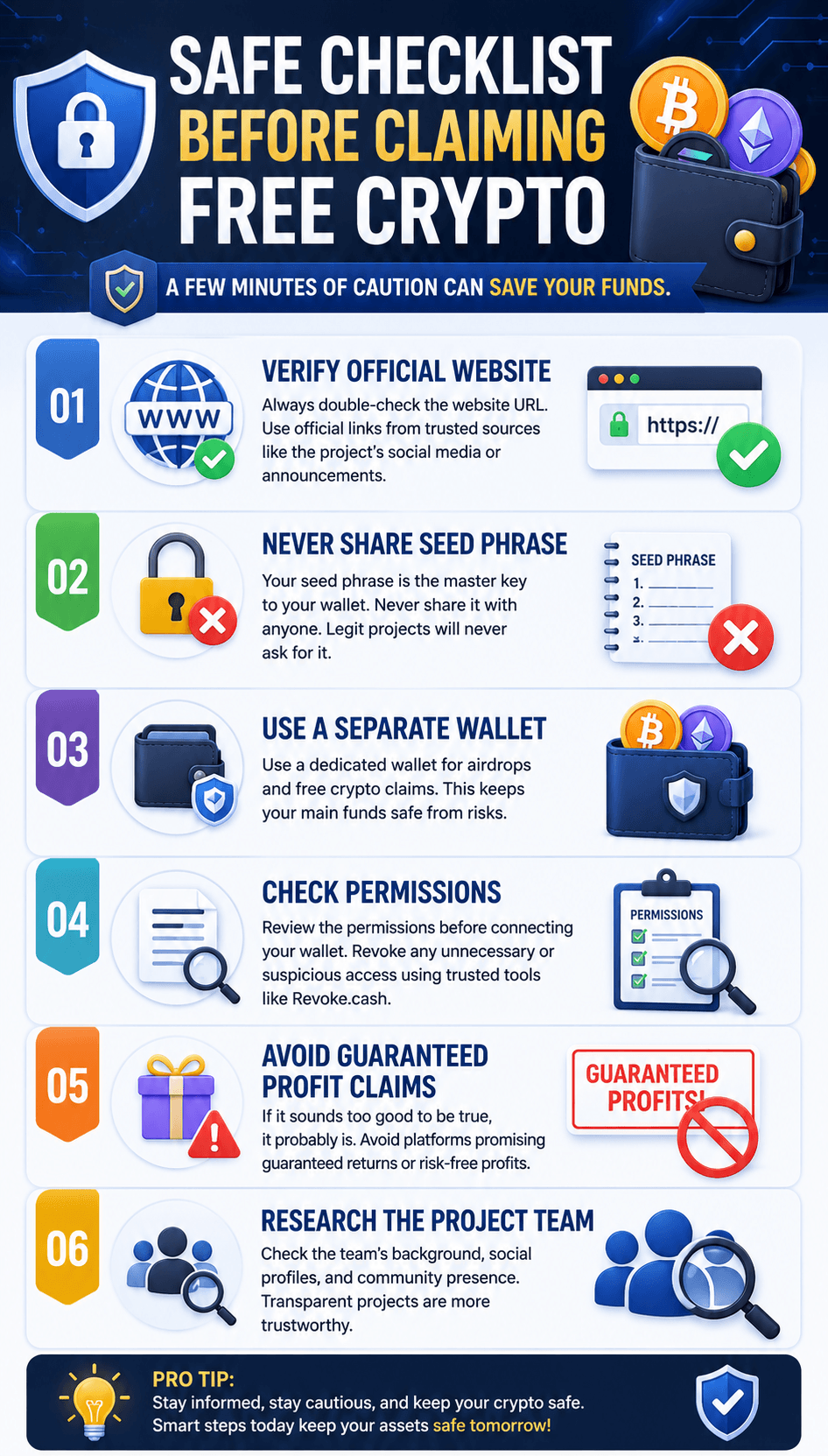
Safe Checklist Before Claiming free coin crypto 🛡️
Before claiming any free coin crypto offer, use this simple safety checklist.
| Safety Check | What to Do |
|---|---|
| Verify the official website | Use links from trusted official accounts only. |
| Check social history | Look for real activity, not sudden fake hype. |
| Never share private keys | No real project needs them. |
| Use a separate wallet | Do not connect your main wallet to unknown sites. |
| Read permissions | Do not approve unlimited token access blindly. |
| Research the team | Look for transparency, history, and real development. |
This checklist does not remove all risk, but it can reduce common beginner mistakes.
Best Practices for Beginners 🌱
Beginners should treat free crypto as a learning tool, not a guaranteed income source. Start small. Read carefully. Take your time.
Use a separate wallet for airdrops and experiments. This keeps your main assets safer. Many experienced crypto users call this a “burner wallet.” It is a wallet used only for risky or unknown interactions.
Do not connect your wallet to every website you see. Every wallet approval matters. Read what the site is asking you to approve. When unsure, stop.
Also, keep records. Write down which projects you joined, when you joined, and what wallet you used. This helps you stay organized.
Another smart habit is to follow official sources. Scammers often create fake groups that look real. Always compare usernames, links, and announcements.
Most importantly, do not let excitement control your choices. In crypto, patience is a superpower.
Free Crypto Rewards
Common Mistakes to Avoid ❌
Many beginners make mistakes because they rush. The most common mistake is sharing a seed phrase. Your seed phrase is the master key to your wallet. Anyone who gets it can take control.
Another mistake is paying to receive “free” crypto. Some real platforms may require normal network fees, but you should be extremely careful if someone asks you to send crypto to unlock a reward.
A third mistake is trusting screenshots. Scammers can fake payment proof, fake comments, fake exchange listings, and fake influencer posts.
Some users also forget about taxes. In some countries, crypto rewards may have tax rules. Always check local laws or ask a qualified adult or professional when needed.
Lastly, beginners often chase every trend. That can lead to spam, stress, and unsafe clicks. Quality matters more than quantity.
Helpful External Resources 🔗
For safety guidance, you can read these official and educational resources:
FAQs About Free Crypto Coins ❓
1. Is free crypto really free?
Sometimes, yes. Some projects give free tokens as rewards. However, you may still pay network fees, spend time completing tasks, or face privacy risks.
2. Can free crypto make me rich?
It is possible for some tokens to grow in value, but it is not common or guaranteed. Treat free crypto as education, not a promise of wealth.
3. What is a crypto airdrop?
A crypto airdrop is when a project distributes tokens to users, often to promote a new blockchain, app, or community.
4. Is it safe to connect my wallet to an airdrop site?
Only connect your wallet after checking the official source, website, permissions, and project reputation. Use a separate wallet when possible.
5. What should I never share?
Never share your seed phrase, private key, passwords, or security codes. No real giveaway needs them.
6. Why do scammers use fake free crypto offers?
Because “free” attracts attention. Scammers use fake offers to steal wallet access, personal information, or crypto funds.
7. What is the safest way to learn about crypto?
Start with trusted educational resources, use small amounts, avoid pressure, and ask a knowledgeable adult or professional before making big decisions.
Conclusion: Explore Carefully and Stay Smart 🚀
free coin crypto can be exciting for beginners who want to learn about blockchain without spending much money. Airdrops, learn-to-earn programs, testnets, and community rewards can all provide useful learning experiences.
Still, safety must come first. The crypto world moves fast, and scammers move fast too. Never share your seed phrase. Never trust guaranteed profits. Never rush because of hype.
The best approach is simple: learn slowly, verify everything, use safe wallet habits, and treat free crypto as education before opportunity. When you stay careful, you can explore the crypto space with more confidence and less risk. 😎